

high cholesterol & the punishment phase
yes, we are back from France and we have dues to pay... plus writing memoir

Please, hit the share button. It matters in the substack world.
Bonjour-Bonjour,
Yes, we have returned from our 7 month sejour in France… and it’s hard.
The best things about our flight home…
Amazing breakfast at Charles de Gaulle airport, the softest scrambled eggs with perfect sautéed mushrooms, served on bistro plates with nice flatware and fresh orange juice. I know…. surprising and bittersweet. A bit of a swan song.
The joy of an empty seat between us. In fact, the plane was only half full. No one wants to come to the states… go figure.
We watched One Battle After Another. It was terrific! Sean Penn did a particularly wonderful job. (And yes, in the photo below, my dear husband, who hoarded his final baguette, does look a bit like Mr. Penn.)
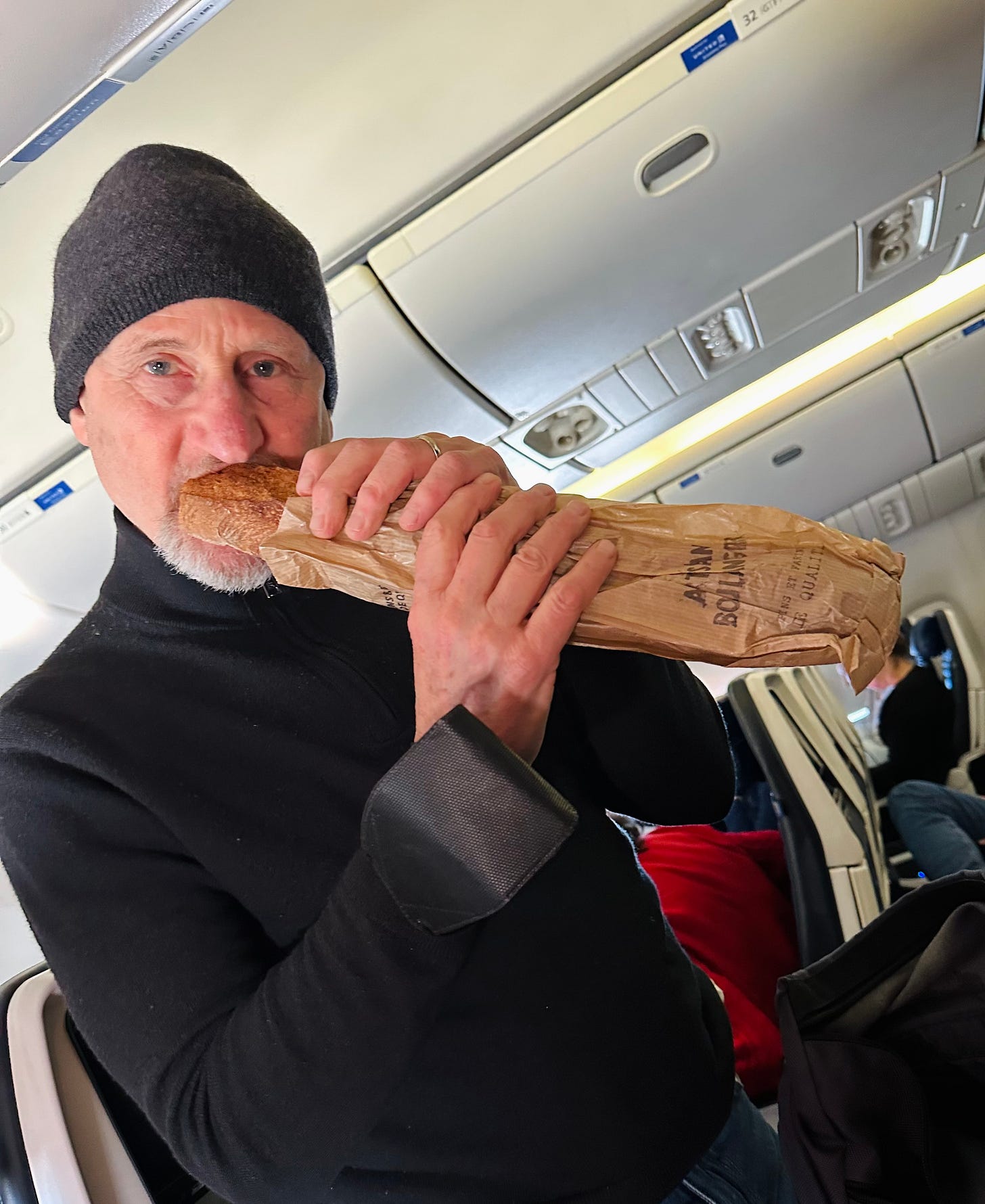
our last authentic baguette… consumed on the flight home Customs was a swift breeze. We were worried for no reason.
Beloved friends, our chosen family, greeted us at the Portland airport. They parked the car! They came in! They gave the best hugs.
The hardest things upon return:
Jetlag is real. If anyone wants to discuss ICE camps in our cities, Epstein war, voter suppression, personal struggles, frustrations, disappointment, all the faults and meanness of my character1, any and all things bleak, I’m available at about 2:45 every morning when my eyes slam open and I cannot go back to sleep. Dial me!
Inflation at the grocery store. $2 for a lemon? It is shocking and real.
Driving. I haven’t been behind the wheel for seven months, and I didn’t miss it a whit.
Not hearing spoken French. I know, sounds minor, but it reminds me of this from David Foster Wallace’s commencement speech at Kenyon College:
There are these two young fish swimming along and they happen to meet an older fish swimming the other way, who nods at them and says “Morning, boys. How’s the water?” And the two young fish swim on for a bit, and then eventually one of them looks over at the other and goes “What the hell is water?”
Swimming all day everyday in a language I didn’t fully understand kept me alert, awake, aware. That’s our job, right? Being in a foreign culture made it a bit easier for me to do the job of being present in my life. I couldn’t become numb to the world.
Best things about home:
Our people!
Our bed
My pots and pans and a dishwasher
Dinner parties
Stanley bossing the squirrels
Friendly poles around the neighborhood:


I’m certain there is more, I’m just a little beat. What do you love to get back to after you’ve been away?

read:
Alert! Alert!
I’ve curated a special Women’s History Month list of books about women who are strong, weak, and splendid! You can get 15% off by using this code: BSO15 at checkout! Valid until April 1, 2026.
…
Have you read or listened to the NYTs interview with Gisèle Pelicot at their terrific interview podcast? It’s a tough listen, yet I found it impossible to turn away. Madame Pelicot endured the unthinkable at the hands of her husband. He drugged her and invited scores of men into their bedroom to rape her while she was unconscious. If the story isn’t for you, I get it, skip ahead.
What is astonishing and affirming and necessary for me is Madame Pelicot’s message to rape victims: “You must not give up on being happy.”
Her memoir, A HYMN TO LIFE was released in 22 languages, with an English audiobook read by Emma Thompson. Pelicot has embarked upon a whirlwind two-month book tour to illuminate how she survived her ordeal and chose happiness as her revenge.
I’m fully absorbed in the book, and deeply inspired by her choice to make shame change sides (a subtitle to the book). Madame Pelicot, whose body has been stolen from her, whose body has become a piece of evidence, looks unflinchingly at the heinous crimes, the betrayal, and also at the deep pain of questioning everything about her decades long marriage. Was it all a lie? We learn about her childhood in rural France and the deep gratitude she felt for “building the kind of family life I never had - that none of the people I loved ever had.” She continues:
“You don’t get a second chance at life. If I erased everything, it would mean I was dead. And had been for years.”
The entire Pelicot family—parents, children, and grandchildren— are torn apart by the rapes. They’re still struggling to find their footing. The book asks, how do we learn to trust again?
I won’t promise this is an easy read. It’s a powerful read. An important one for me.
The memoir ends with these words, “To fight the emptiness, I need love.”
Opportunities to engage in the r.w.e. community:
If you’d like to discuss books with me and a group of smart and lively readers, the r.w.e. book group selection for April is BUCKEYE, by Patrick Ryan, will be our April book group book, and **Patrick will be joining in our conversation** on Sunday, 12 April at 9a pacific time! I can tell you he is a wonderful writer, excellent editor, and all around good egg! Want to join us? The book group is a perk for paid subscribers. I’d love to get to know you better:
Our May selection will be THIS IS NOT ABOUT US, by Allegra Goodman. We will meet Sunday, 17 May, at 9a pacific time on zoom.
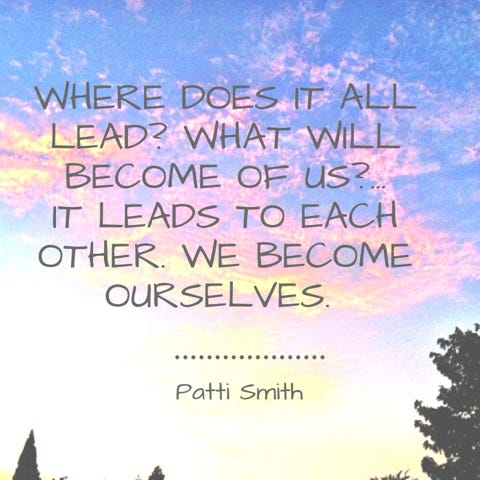
Get this! We also have a Mentor Book Group— in which we read memoirs, personal growth books and discuss what we might like to adopt in our own “work-in-progress” lives. I listened to Patti Smith’s new memoir, BREAD OF ANGELS will be our March book, meeting on 29 March at 9a pacific time. Love to have you join us.
I’ve made a read.write.eat. Bookshop where you will find many of the books I’ve recommended. Buying books from my shop is another way you can support my newsletter. I have made a special Women’s History Month list of books about women who are strong, weak, and splendid!

write:
I’ve been thinking a lot about memoir and form. Not only for my own work, but because several of my students are in the throes of discovering how to get their stories down. What form would best hold the story we need to tell? The story of how we survived. The story of who we were at the start and who we are at the end and how we got there.
You may ask, why not use chronology? And yes, why not? Chronology is tidy, it’s easy to follow, it makes sense. (Mother Mary Comes To Me, Arundhati Roy.)
But what if, in the writing, you’re discovering connections between past you and present you? Connections between your marriage and your parents’ marriage? Your parenting mistakes and how you were raised? Perhaps it would serve the memoir better if these aspects were closer together in the manuscript. Associative connections may be your form. (The Chronology of Water, by Lidia Yucknavitch.)
And, what if you want to tell your story in vignettes, in tiny bouillon cubes of flavor? What does that look like? Meaning is accrued by association, by the way you choose to order your vignettes. It could be chronological, and it could be fractured. (Safekeeping, by Abigail Thomas. The Irish Goodbye, by Beth Ann Fennelly. Community Chest, by Natalie Serber.)
Perhaps the best form for your story is collage. (You Could Make this Place Beautiful, Maggie Smith.) Not only will you include narrative from your life, the forward moving plot—such as a divorce, or caring for a recalcitrant aged and ill mother, but you will also have room for:
quotes from other writers
song lyrics that were meaningful
recipes from your childhood
questions that went unanswered
conversations with a therapist
things your kids said
snippets of letters—written, received, never sent
your favorite outfit when you were twelve
All of this sounds well and good, right? We just have to choose. But how? Consider these questions:
What is your natural form of storytelling?
Which of these forms interests you most?
What memoirs have you read that appealed to you formally? Not because of the content, but because of the way they were told. Give that form a try. Plus, read more memoirs!
Are you willing to experiment?
Which form best suits the story you want to tell?
How to begin?
What is bothering you?
What from your life keeps you up at night?
What do you want to examine, remember, understand today?
What conversation can you not forget and can you make that a scene?
What is a central time period, experience, decision, that defined you?
And, a bonus… take a one-off writing class with me! My bi-monthly Writing Circle is an opportunity to begin to get moments from your story down on the page. We cannot make a decision about form until we have something to with which to work.
…
Join me for an inspiring morning of writing together in early May:

…
I also have a rare spot in my weekly writing workshop! This is a group of talented and wonderful writers, who also happen to be amazing readers of one another’s work. If you are an experienced writer working on a project—stories, novel, memoir, essays—and you’re looking for a community of supportive and likewise experienced writers, if you are looking for deadlines and accountability, this could be perfect for you! Let me know:

eat:
While away we became besties with cheese and butter, with frequent desserts, with red meat. Ahem, my husband’s cholesterol… through the roof! Currently we are in the punishment phase!
To make amends, in a rather pleasant way, I’ve made this salad three times in five days. I think you should make it too!
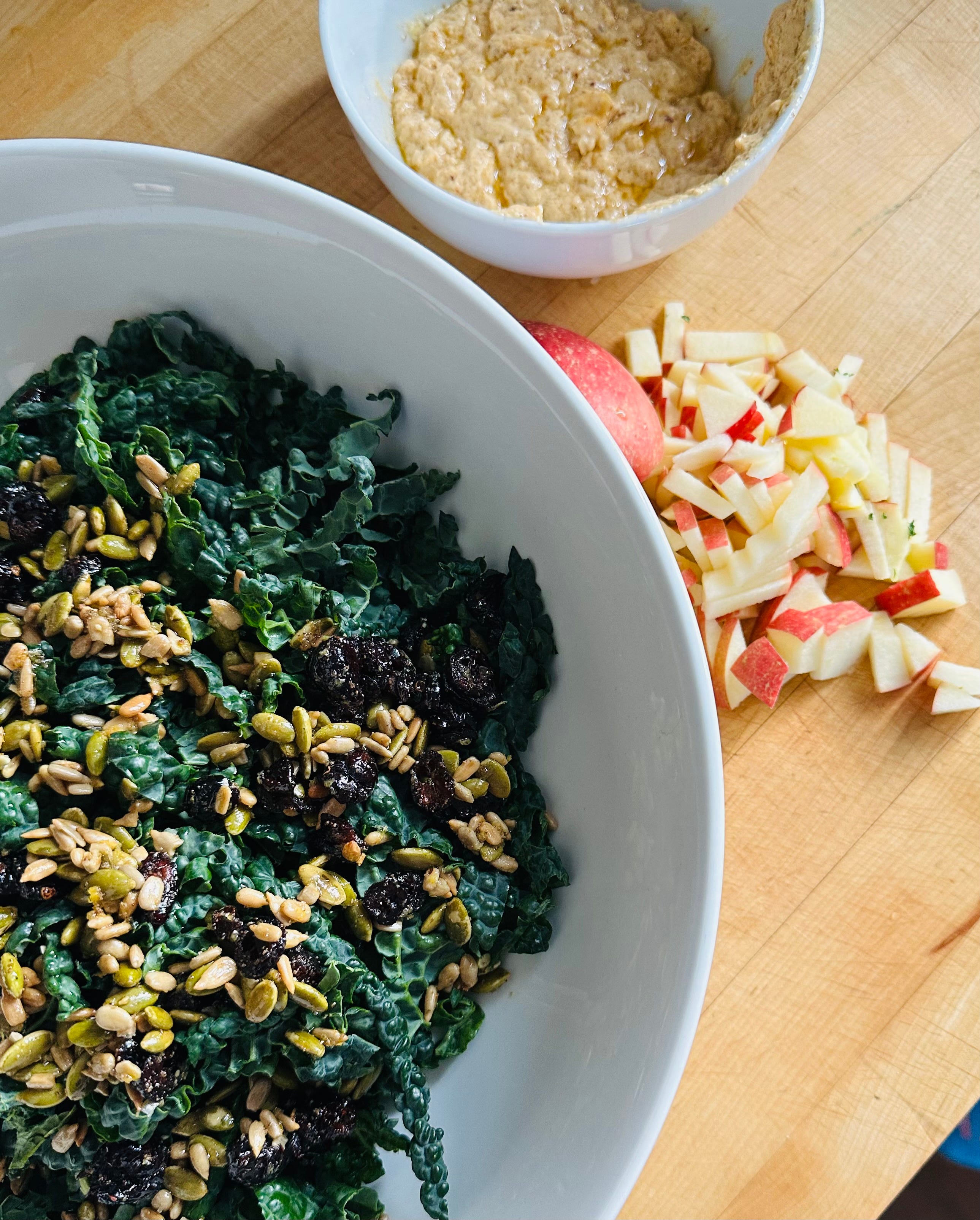
Seedy Kale Salad
Dressing
1 med garlic clove
⅓ cup extra-virgin olive oil
¼ cup almond butter
¼ cup fresh lemon juice
¼ cup white wine vinegar
2 tsp. chile paste
1 t honey
Kosher salt
Put all the ingredients in a capsule blender or small food processor, + 2T water and whirr until thick and smooth. Taste dressing; season with more salt if needed. And/or you may want to add a bit more olive oil. Use your own taste buds. Dressing can be made 1 day ahead. Cover and chill.
Salad
2 Tbsp. extra-virgin olive oil
¼ cup each toasted-shelled sunflower seeds and toasted-shelled pumpkin seeds
Zest of 1 lemon
⅓ cup dried cranberries
1 apple diced
Kosher salt
1 bunch Tuscan kale, ribs and stems removed, leaves thinly sliced, washed
In a small bowl mix sunflower seeds pumpkin seeds, lemon zest, dried cranberries, 2 T olive oil, and a large pinch of kosher salt. Stir to combine.
Transfer about a quarter of the salad dressing to a large bowl. Add prepared kale and, using your hands, massage dressing into kale to soften slightly. Add remaining dressing and about a half of the nut mixture. Toss to coat evenly.
Slice the apple into small chunks. Add to the salad. Toss again. (For one of the versions of this salad, I also added about 5 sliced radishes. It was not a bad idea!)
Top with the remaining nut mixture. Delicious!
I promise, this will heal what ails you!
Stanley, indignant at Charles de Gaulle airport:

If you find yourself regularly reading and enjoying my work and you’d like to show some thanks, you can do so with this charming button:
If you aren’t ready to hop on, yet you wish to send a little love my way:
…
Thanks for being here with me.
Tell your people you love them, and take care of your skin!

PS:
In case you missed it, here are a couple missives from our time here in France.


And, to stay in the loop:
a quote from the terrific novel, SPARE ROOM, by Helen Garner.
Bienvenue chez vous! It was a treat following along on your adventure.
Welcome home! And great weather & cherry blossoms for it too. I would be interested in learning more about the writing group.