

Father Shaped Hole
The last time my mother saw my father he was delivering her suitcase and 10 twenty-dollar bills to the Maternity Ward at St. Vincent’s hospital in NYC. It was 1962. He’d given my mother a choice: give up the baby and stay with him—or—give up him and stay with the baby.
Spoiler, she kept the baby.
Throughout my childhood my missing father wasn’t a present absence. There was no father shaped hole. Yes, at times there was a yawning man shaped hole for my mother, but mostly she and I simply were.
At 16 a switch flipped and I had a sudden interest. I told my mom. My mom told my grandma in Hallandale, Florida. She told my father’s mother who lived in Hollywood, the next town over, and she told my father. It was like the Twilight Bark, in 101 Dalmatians, the way dogs alert each other about dangers. Soon enough, I had his address.
“Dear Peter, I’m here in California. I’m 16. I wonder if you want to meet me?”
I included my information and presently I had an answer. A registered letter arrived, addressed to me. Inside a note, a roundtrip plane ticket to Los Angeles, where he would be traveling for business, and a tiny black box. Popped open, there nested small diamond studs.
“Motherfucker,” my mother said. “This is how he waltzes back into your life?”
I tried not to seem pleased. They were an insult to my mother. This deadbeat dad sending jewelry to a 16-year-old. Plus, he mentioned he had a chain of jewelry stores in the Ft. Lauderdale area and would be in LA for a jewelry show.
“Motherfucker,” my mother said again. Last Christmas when I’d asked her for a $40-dollar puka shell necklace she told me to want in one hand and spit in the other and see which fills up faster. Only she didn’t say spit.
I wore the earrings.
After much fretting about how to dress to meet my father, I choose a teal green t-shirt dress, a hot pink scarf tied around my waist, and platform sandals. I was used to flying alone, something I’d done since I was five, visiting my grandmother every summer to swim, eat BLTs , and dodge the salad-plate sized land crabs on her street. It was the getting off the plane that worried me. I waited till half the plane emptied, smoothed my hair and unbuckled. Families and friends embraced among the orange plastic chairs. Men in natty suits with wide lapels toted briefcases and checked their watches. I tried my best to look not-alone. Solitude is the most embarrassing thing for a teenager and here I was, solo among strangers with no place to be, no one to collect me. The gate emptied and then it filled. The new batch of flight attendants in chic hats and snappy dresses arrived. Passengers read Time Magazine. More than dejected, I was scared. I had $38 dollars plus change for the phone.
“Motherfucker,” my mother said when I called.
She took the phone number, told me to stay put, and promised she’d call back in 20 minutes with a plan. The phone rang. “Sweetie, listen up,” she began. But there he was and I was embarrassed that I was caught on the phone with my mom, basically telling on him. “He’s here,” I mumbled, and hung up.
“Natalie?” He paused in front of me, taking the wide stance tall men use to diminish their height, he said my name again and sort of ducked his chin. In cowboy boots, a big silver belt buckle, wet marks smudged his armpits. This was the man I’d been imagining since I got the earrings and tickets. He’d played football in college, he had high cheekbones like me, dark eyes that wouldn’t quite look at my face. It wasn’t as if he was dying of thirst in a desert and had finally found clean water to drink. I didn’t feel I solved any problems for him, didn’t fill a daughter shaped hole. He ran his palm over very short black hair. “Sorry to be late,” he slurred.
I instantly knew this stranger—my dad, was drunk. The phone rang. Of course it was for me. “He’s here. I think he’s drunk?” I whispered.
“Motherfucker.”
“Sorry,” he said again. “I was scared.”
Where was I supposed to put that? He was scared I’d be mad? He was scared I’d be worried? He was scared he wouldn’t like me and be stuck with me?
“It’s okay,” I said.
“No, it’s not okay,” my mother said.
“I gotta go.”
“Call me in an hour. Call me!”
Here I was, a kid with a mom and a dad, caught in the middle of their strain. I didn’t even realize that this was part of family too, something I’d missed, an awkward and hard triangle. I was normal!
At the jewelry show I got a badge. Folino Jewelers. Natalie Folino. I was the owner’s daughter. I’d been claimed. Sometimes he rested his hand on my shoulder. Sometimes pointed at a gem. He shook a lot of hands, his shirt cuff rising to reveal hairy wrists and a gold watch. At a fancy steakhouse, with sawdust on the floor, everything on the menu was á la carte. Spinach. Baked potatoes. Sautéed mushrooms. A chunk of bloody meat. I was served red wine. When I went to the bathroom I stopped to call my mom again. “We’re at The Palms,” I said.
“Motherfucker.”
The day—the flight, the waiting, the jewelry show—had been a performance. Me trying to be what he wanted. Pleasing. Pretty. Smart. Funny. Quiet. Grateful. And maybe he’d been performing as well. In the hotel lobby he loped across the white marble floor with a loose and easy stride. The bellman in his jaunty cap called out to my father, “Good evening.” He fluttered his hand. It was nearly everything I’d wanted. The dream of being rescued from the perpetual drama of life with my mother…lost keys, fender-benders, overdue bills, trouble at her work, men, diets, petty anger, and sadness. My father was my dream of having a reality check and another place to go.
“I’m tired. You?” he asked and I agreed. The ding for the elevator was like a velvet clang on a crystal bell. And then, on the 14th floor, he unlocked the door to a single room. We were sharing. There were two beds of course. Nothing untoward or scary. Just terribly awkward. It was as if we had a history we’d never had. The single room seemed to erase the abandonment without ever talking about it. Except it didn’t. Instead of it being just what families did, shared a room, it felt like a huge denial. He was saying, this is us now, without acknowledging we’d never been an us before. He’d never tucked me in, put a thermometer in my mouth, yelled at me when I put a fork in the toaster, or waited up for me when I missed my curfew. I quickly dressed in pajamas and brushed my teeth then burritoed myself in my bed. Before I slept, I heard him on the bathroom phone, saying goodnight to his wife.
…
Soon after I flew to Florida where I would stay two weeks with my grandma and meet his family. His German wife, tall, blonde, and, I felt, a bit cold. I don’t know if that is true or if it’s my learned behavior, expecting the disdain sit-com moms exude for the ex-wife, for the kid from another woman. Perhaps she just didn’t radiate warmth in the same way effusive women in my family displayed their emotions. She scared me with her bright nails, many glittering rings and the cut glass highball she shook, rattling ice cubes. I had a sister who immediately loved her new big sister and enthusiastically served me a bowl of lychee fruit I had no idea how to eat. My brother looked just like his mom. He shot me with silver revolvers he yanked from a holster he wore around his little boy hips.
“Bang. Pew. Kapow.”
Their living room was not unlike the hotel lobby, sunken, thick white carpet, gold veined mirror tiles, a chandelier. It was the opposite of every apartment and rental house my mother and I had lived in. Our furniture performed double duty, always—bed/couch, table/desk, electrical wire spool/coffee table. They had a chaise longue.
“Here you go,” my father held out a ring of keys. “Use my truck while you’re here.” A blue Chevy pick-up, or some other large monstrosity hunkered in the driveway. “You can drive right? You have your license?”
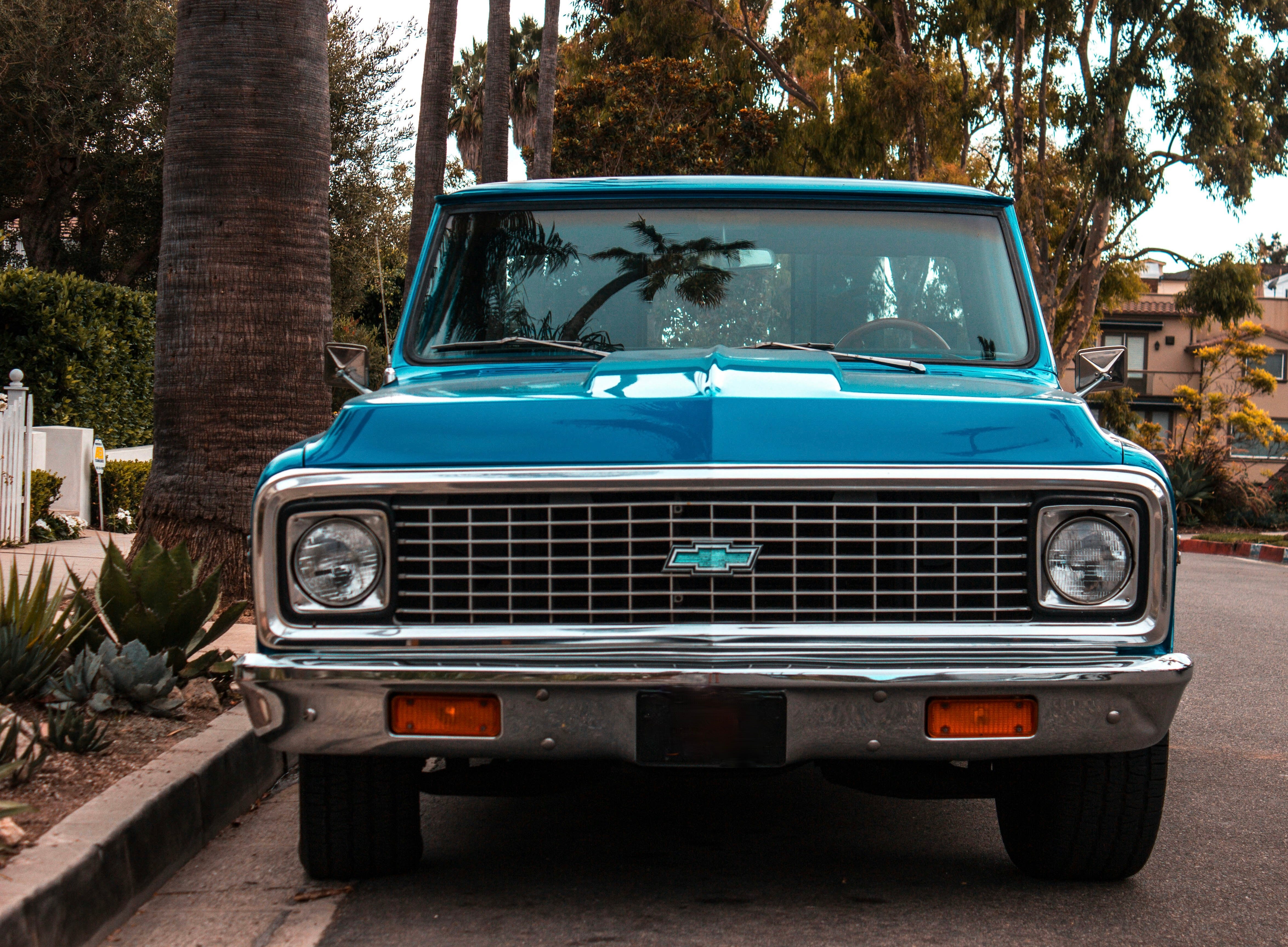
He showed me the gears on the steering column, slid the bench seat closer to the steering wheel, made certain my feet reached the pedals, and rattled off directions to the highway.
I thanked him. When he asked if I liked my siblings I cried yes! Of course! Who wouldn’t? What I didn’t ask, does your wife like me? Are you glad I wrote to you? Are you sorry you left me in the hospital when I was born? Did you miss me? What I didn’t tell him, I do not have my license. I do not know how to drive.
I didn’t tell my father I couldn’t drive because I thought it would reflect badly on my mother. I didn’t want him to have ammunition to disparage her, to think she’d forgotten to teach me a life skill. The truth was we had just one car. I rode my bike everywhere. Santa Cruz was small. Also I believed that a 17-year-old who couldn’t drive was a loser. I didn’t want to be a loser. So I drove. Somehow I pulled out of his driveway. My diamond earrings glinting, my hands squeezing the wheel. I was performing American Teenager for a father who didn’t know me.
When I pulled up at my grandma’s she stepped onto the stoop, the screen door slapping shut behind her.
“Since when can you drive?”
“Oh, didn’t I tell you?” I la-dee-dah-ed, jingling the keys in my hand.
I drove the truck back and forth for two weeks and never got very good. Swerving to avoid the irrigation ditches. Driving too slow. Leaning far forward, peering over the steering wheel trying to see the road ahead.
…
Early winter of my senior year, my mom’s boyfriend was moving in. She asked me when I planned on moving out.
“Now,” I said.
I had a best friend who also needed to live away from her parents. School for me was only half day. I worked two jobs, waitress and aerobics instructor. My father knew I was living on my own and he sent me $200 a month to help out.
“Now he sends child support?” my mother said. “Motherfucker.”
The money was a veneer of security, and it continued after I graduated and half-assedly attended community college. Nearly a year later I received a bill from the IRS informing me I owed $700 in back taxes. My father, it turned out, had been claiming me, not as his daughter, but as a freelance jewelry designer.
“Motherfucker.”
I didn’t understand. I lay on my double bed in the cottage I’d rented with my friend, staring up at the tapestry I’d thumbtacked to the ceiling. Carole King or Bonnie Raitt may have been on my hifi, another gift from my father. Like the earrings and the fake freedom of the keys to his truck, the gifts were things teens supposedly loved. And I did love them. But they weren’t really meant for me. They weren’t an attempt to know me better. I supposed the closest I’d felt to him was when I had the badge on, Folino Jewelers. Natalie Folino.
At the end of the visit, when it had been time for me to fly home from Florida, my father drove me to my grandma’s, we hugged in the truck.
“Don’t be afraid of math,” he said.
“Okay.” I walked toward the house. He crunched back down the oystershell driveway. His math advice was perfect and probably the most intimate thing he knew about me. I was terrified of math.
I called the IRS and arranged to pay back the money. Seventy dollars a month. I remember this so clearly because it was the same as the car payment on my 1965 VW bug—white with red vinyl seats. I loved that car till the block cracked and I couldn’t afford to fix it. I paid my bills. I worked two jobs. I attended classes without much luster. And I didn’t speak to my father for many years. Neither of us knew how to speak to one another. It’s funny. All those years my life didn’t have a father shaped hole until now it did.
…
Thank you, for reading.
If you enjoyed what you read, maybe you want to share with someone who would like to feel less alone.
I was here.
I felt this.
Did you ever feel this too?
Tell your people you love them, and take care of your skin,
